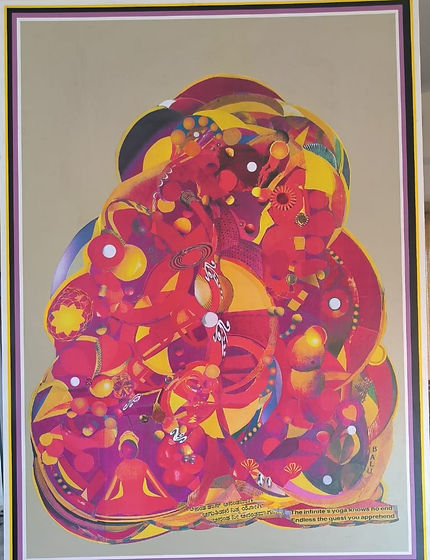
About Dr. V Balu

Who was Dr. V.Balu?
Dr. V. BALU (Venkatraman BALU) was a creative communicator based in Bangalore, India. As an artist, he started off with cartoons and oil paintings. However, for over four decades, his main medium has been paper collages. In addition, he was a writer who has authored books and numerous articles.
How was he promoting Peace Through Art?
He had created several collages on the theme of peace. He had also written eight books on peace. Since 1982, he has been traveling the world trying to share his art and thoughts on peace with individuals and groups


Why should you care?
His artworks were created as a result of his meditation. Onlookers have commented that his compositions and colors evoke peaceful vibrations. His interactive presentations promoted the knowledge of inner peace and stressed the role of individuals in planetary peace.
In the Hands of Artist V. Balu, Waste Paper is Not Wasted!
... by Ron Scherer, Staff writer of The Christian Science Monitor, ET|NEW YORK. Aug. 17, 1993
Tubes of paint can be expensive, especially in a poor country such as India. But there are still plenty of opportunities for an artist to find expression by using paper. Just ask V. Balu, an artist from Bangalore in Southern India.
Mr. Balu uses paper to form collages. He salvages waste paper, old magazines, chocolate wrappers, almost any kind of paper he can get his hands on. He finds papers with subtle pastels, somber browns, and intricate details. He estimates he has used at least 3,000 different types of paper and still has 4,000 left to try. Some of his creations use thousands of pieces of paper.
"Why should people go to expensive paints when the modern advances in technology and printing give you such a variety of hues and colors, shades and tones?" asks the artist during a visit to the United States. About these ads, Collage, of course, is not new. In fact, while digging through his grandmother's steamer trunk, Balu found some exotic paintings, dating from the 1880s, of Indian gods and goddess with cloth and baubles stitched onto the artwork. He argues this is the earliest form of collage. In the West, collage is most closely associated with Pablo Picasso. In 1912, Picasso began experimenting with collage, using newspaper clippings, pieces of debris, and stenciled words. Other artists such as Braque, Gris, and Matisse expanded on the technique.
What distinguishes Balu is that he usually works totally in paper, not mixed media. With a large collection of scissors, he carefully cuts the paper, glues it to a backing, and uses a wooden roller for a seamless look.
The self-taught Balu sort of backed into the art world. He had written some stories for the Indian Express, which did not have an artist to illustrate them. The paper asked him to illustrate them himself, which he did. He became more deeply involved in using art for communication and 35 years ago began producing collages.
Balu has used the collage method for a variety of themes. He has done a series of collages based on a Kannada (South Indian) poem, "The Unhoused Consciousness." He has used the medium for series on horses, science and technology, spirituality, and philosophy. "I can express any theme I want with this medium", the artist says.
He is most proud of his collages based on the concept of peace. He began his peace works about 11 years ago and has since done about 60 works on the theme. "They explain the mystique of peace, its different manifestation, the attempts of people to obtain external peace, nature as a teacher of peace, the views of different messengers of peace, and the difference between the Eastern and Western approaches", he explains. Last May, UNESCO featured an exhibition of his peace collages.
Balu's unusual technique has resulted in some commercial uses of his work. A department store in Denmark printed one of his collages on its plastic bags. Reader's Digest featured his work on a cover. There is also a Balu collage on an Indian first day (postage) cover. Balu, who is a publicist in India, encourages the commercial efforts. "I want to popularize this medium because it is so simple", he says.
No expensive paints - just paper.
Link to this article

Global Peace Activist, Crusader for Peace and Artist Of Peace
Described by the media, as a Global Peace Activist, Crusader for Peace and Artist Of Peace, V.BALU (Venkatraman Balu) of Bangalore, India, is known for what has been called a "ONE MAN GLOBAL PEACE MISSION THROUGH ART". Since 1982, as part of this mission, he has been involved in peace education through creative communications and interaction with people, to motivate individuals to relate to their INNER PEACE and play their part in achieving global peace.
He believes that INDIVIDUALS FOR PEACE is the best approach, since WORLD PEACE is not a WORLD PROBLEM but an INDIVIDUAL problem.
The "One Man Global Peace Mission" is not elaborate. It is just one man (V. Balu) working with his resources and skills to spread the message of peace. The Peace Presentations are free of charge; for, to quote him, "Peace is everyone's birthright, if not life-breath!".
Peace presentations have already been organized at different centers in India; at the Johannestift organization in Berlin; at the UNESCO Headquarters in Paris; the Belgian organization in Dilbeek, Belgium; at the Bharatiya Vidya Bhavan in London; at the United Nations Dag Hammerskjold Auditorium, and the premises of the Permanent Mission Of India to the U.N., NewYork; the St. Bonaventure University; the New York University; the India club at Cornell university; the Art Institute of Boston; the Students Association at MIT; the Rhode Island College; at an international convention in Atlanta; the Brock University and Dawson College in Canada.
The UNESCO office in Mexico and the Embassy of India, arranged a special presentation cum one man conference in Mexico on the theme "From a Year of Peace to an Era of Peace". A month long programme was organized in South Africa at the premises of the Indian Consulate Generals In Durban and Johannesburg; at the University of Durban Westville; at the Seva Samaj premises in Cape Town and at the Natal Museum Auditorium in Pietermaritzburg. His Peace Presentations in Abu Dhabi and Dubai in the United Arab Emirates and at the City Civic Hall in Hamilton, Canada met with tremendous response.
Other sites that have seen his presentations include Canberra, Melbourne, Brisbane, Sydney and Adelaide in Australia; Auckland in New Zealand and Colombo in Sri Lanka.
His Holiness The DALAI LAMA:
"I have praise for your work for peace through individual persuasion and my prayers for success in your work".
Archbishop DESMOND TUTU:
"As you proceed on your global mission, may your journey increase understanding and bring peace to others".
Mayor of Hamilton, Canada, ROBERT M. MORROW:
"I have had the greatest pleasure to see your wonderful work and to chat with you. By your selfless contribution, you are giving a new vision of peace to people round the world".


New Zealand's High Commissioner to India / First person to climb Mount Everest Sir EDMUND HILLARY:
"Superb colours and a fine representation of true peace".
Director General, UNESCO, Paris FEDERICO MAYOR:
"I appreciate the meaning, the spirit and the human touch behind the peace collages, the aesthetics of which are superb and the technique extremely original"

Balu's Books
Self-taught, V.Balu's artistic career began with cartoons and illustrations for his own stories and articles. He also did oils in the impressionistic style but soon moved over to paper collages, a medium he has been using for over four decades. A former senior Government executive and an expert in creative communications, V. Balu is also a science writer with more than 2000 articles to his credit. He has edited technical magazines and is the author of books on humour, spirituality and stories for children.
Balu's collages have been used on first day covers by the Indian Posts and Telegraph Department; on the covers of magazines such as the Reader's Digest and in all 30 language editions of the UNESCO Courier; on shopping bags in Denmark; on greeting cards by UNICEF and other organizations; for videographic communication of poetry; for raising funds by several organizations and for award-winning wall and desk calendars on the themes of tolerence, non-violence, peace and unity of mankind. His works are in public and private collections around the world.
Three elements comprise Balu's peace presentations:
i. Exhibition of collages on peace
ii. Audio-visual presentation on Inner Peace and the role of Individuals in global peace, and
iii. A Peace Workshop: Question & Answer sessions and discussion of case studies

SADAA SHANTI
(Perpetual Peace) by V.BalNo of Pages: 77
Illustrations: 16
About the book: The book is a culmination of V Balu’s work as a global peace activist and lays emphasis on inner peace and the role of individuals in global peace, the need of the day. The book begins with a peace prayer and then talks of faith, renunciation, inner peace, mental and global peace and global peace through art.
More details: Don’t worry, be happy is one of the chapters in this book where he has reminded the readers that worry never solves any problem. Worry is a self created mental condition and is the result of factors like lack of contentment, he says and has given various examples to substantiate his words.
According to the newspaper, The Asian Age, "In this book the color plates showcase the art of a brilliant collage artist who has dedicated his exceptional talent to the cause of promoting peace… The creations wrought with bits of paper and a pair of scissors exude the stillness that draws you into an understanding of his message. An understanding that defies verbose intellectual interpretations. The real bonus of purchasing or gifting Sadaa Shanti to someone is that you will meet an artist whose collages have the power to communicate the most esoteric ideas effortlessly. The distinctly user-friendly approach of the publication are large and easy to read type face and break up of chapters that is conducive to partaking of small doses of the exalted but easy to digest thoughts, perhaps just before bedtime".
SHANTI SOPANA
Steps to Peace by V.Balu
No of Pages: 108
Illustrations: 38
About the book: The author has advocated twenty two steps to peace in this book. They include curbing anger, thinking positive, removing ego etc. They take the reader to the serene waters of the lake of peace. They are all well thought and do not seem unattainable to anyone who reads them.
More details: There are several anecdotes and stories told in the book to make the reader understand the steps to peace. There is no preaching or moralizing, only sharing and listening. One of the interesting stories is of a man who walked all the way to the next forest from the one where he lived, along with a lamp, to borrow a match to light cigarette. He did not realize that he could do so with his own kerosene lamp. People miss the light of peace within and grope in the darkness of ignorance.
Such stories dot the book making it more interesting to read.
Another story is of a forever-angry father whose son keeps laughing when his father is angry. When the father angrily asks him the reason for smiling, the son replies that when he is angry he looks like an ape and brings a mirror to show the man his face while angry.

.png)
SHANTI DARSHAN
Messengers of Peace by V.Balu
No of Pages: 81
Illustrations: 36
About the book: Sathya Sai Baba, Dalai Lama, Sri Krishna, Mahatma Gandhi, Aurobindo, Mother Teresa and several others are all messengers of peace. The book has been printed on good paper and has pictures of the peace messengers and special quotations from them.
More details: ‘In the sentence I WANT PEACE strike out I (or ego) and want (desire) and peace be with you’ says Bhagavan Sathya Sai Baba in the opening colourful page. ‘If you want peace of mind do not find fault with others, rather see your own faults’ says Holy Mother Sarada Devi.
SRISHTI - Collages: The fine art of V.Balu
ITC's Book on V.Balu
No of Pages: 100
Illustrations: 79
Shristi represents V.Balu's artistic odyssey. From his early days as an adept cartoonist and painter to his unique collages, which have been his artistic expression for years. Through this medium he eloquently expresses his vision and innermost feelings in a wide variety of themes.
In the Afterword to the book, novelist Mulk Raj Anand writes,"The book reflects the transition from experiment to achievement. Collage pictures in the hands of an accomplished artist like Balu attempt to give form to percepts, so that they may convey a concept. In the radiance of various pictures, his imagination takes wings and releases warbled rhythms, reaching out to visions unseen..."